The platform

One governed operating layer for evidence strategy.

EvidenceSync aggregates evidence inputs, structures them into evidence objects, connects them through a knowledge graph, uncovers evidence gaps, defines source-backed actions, and carries the work through review, execution, and Data Dissemination Planning.

The canonical workflow

Connect the evidence. Find the gaps. Define the actions. Defend the strategy.

EvidenceSync creates a closed loop for evidence work. It finds what is missing, defines what to do, scores what matters, routes work to the right teams, and preserves the rationale behind every evidence decision. The sections below walk the workflow stage by stage.

The gap-to-action loop
01
Aggregate
02
Structure
03
Connect
04
Detect Gaps
05
Define Actions
06
Prioritize
07
Review
08
Execute
09
Disseminate
10
Defend
Governance: RBAC, audit trails, source traceability, claim integrityConstant across all ten stages
IEP enters at AggregateDDP is produced at Disseminate
Stage 01 · Aggregate

Aggregate evidence inputs

EvidenceSync gives evidence teams one place to bring together the inputs that normally stay trapped in decks, trackers, documents, inboxes, and disconnected systems.

Integrated Evidence PlansData Dissemination PlansStudy documentsClinical evidenceRWE outputsAdvisory board notesMedical insightsCongress activityPublication plansLiteratureRegulatory evidence requirementsPayer and HTA requirementsInternal review commentsStakeholder feedbackCustomer repositories
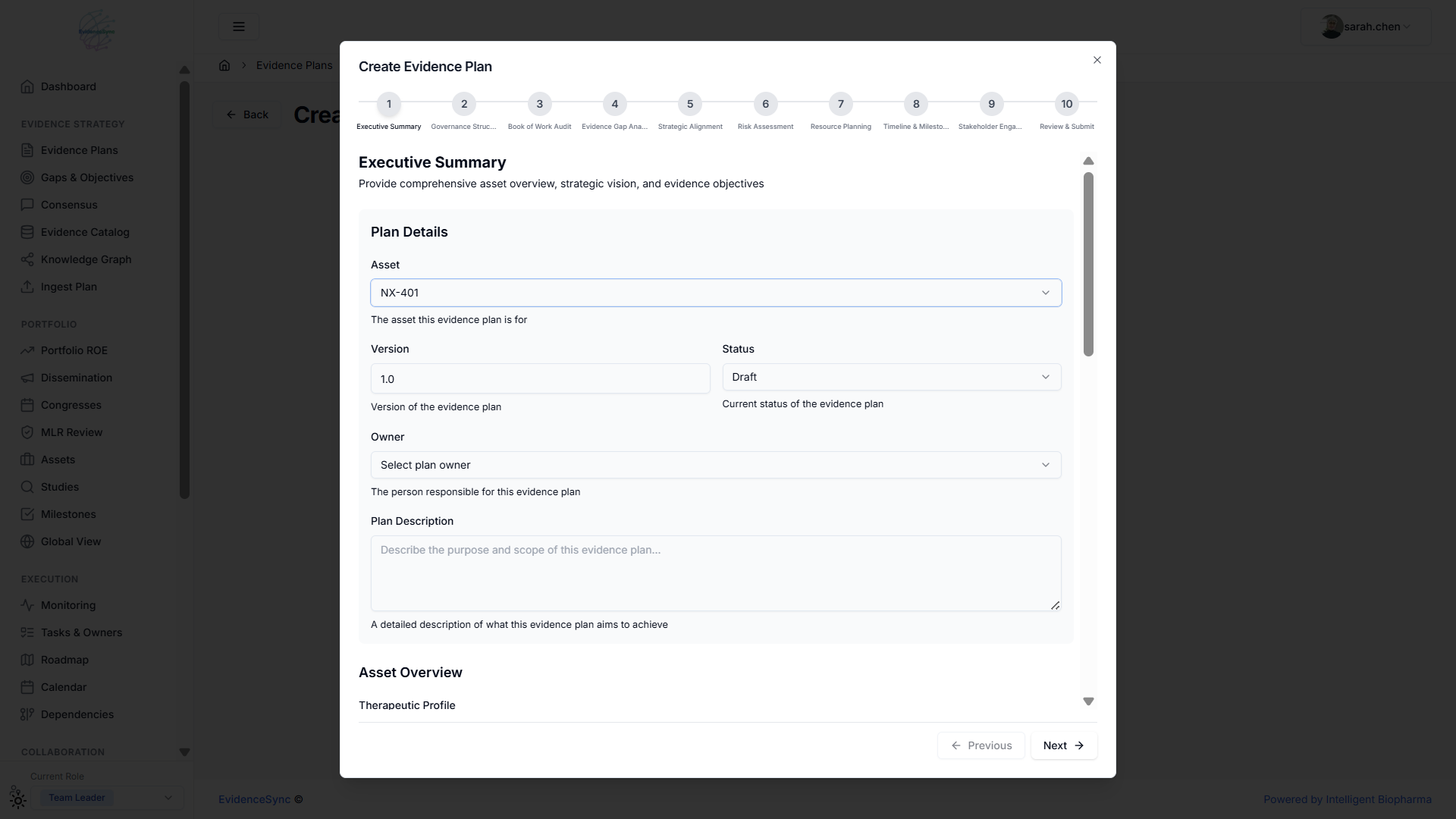
EvidenceSync Create Evidence Plan wizard showing the Executive Summary step with plan details for asset NX-401
Evidence Plan Builder
Stage 02 · Structure

Structure evidence intelligence

Agentic AI turns unstructured evidence material into structured, reviewable, source-backed objects.

Evidence claimsStudy objectivesEvidence gapsRisksData sourcesActivity milestonesStakeholder needsRegional requirementsClaims needing supportReview dependenciesDissemination opportunitiesNext-best recommendations
Stage 03 · Connect

Connect through the evidence knowledge graph

The knowledge graph breaks silos by making relationships explicit. Teams no longer manage disconnected evidence artifacts. They manage one governed evidence record.

AssetsIndicationsEvidence objectivesStudiesClaimsEvidence gapsRecommended actionsData sourcesPublicationsCongressesStakeholdersGeographiesRegulatory scenariosPayer needsDissemination activitiesReview statusROE scores
The data foundation

EvidenceSync does not manage documents. It manages evidence objects.

Documents, plans, publications, insights, and studies become structured evidence objects connected by source, claim, objective, gap, stakeholder, activity, action, and dissemination pathway.

AssetIndicationEvidence objectiveEvidence activityStudyData sourceClaimEvidence gapRecommended actionStakeholder needPublicationCongressInsightReview decisionDissemination outputROE score
Stage 04 · Detect Gaps

Evidence Gap Intelligence

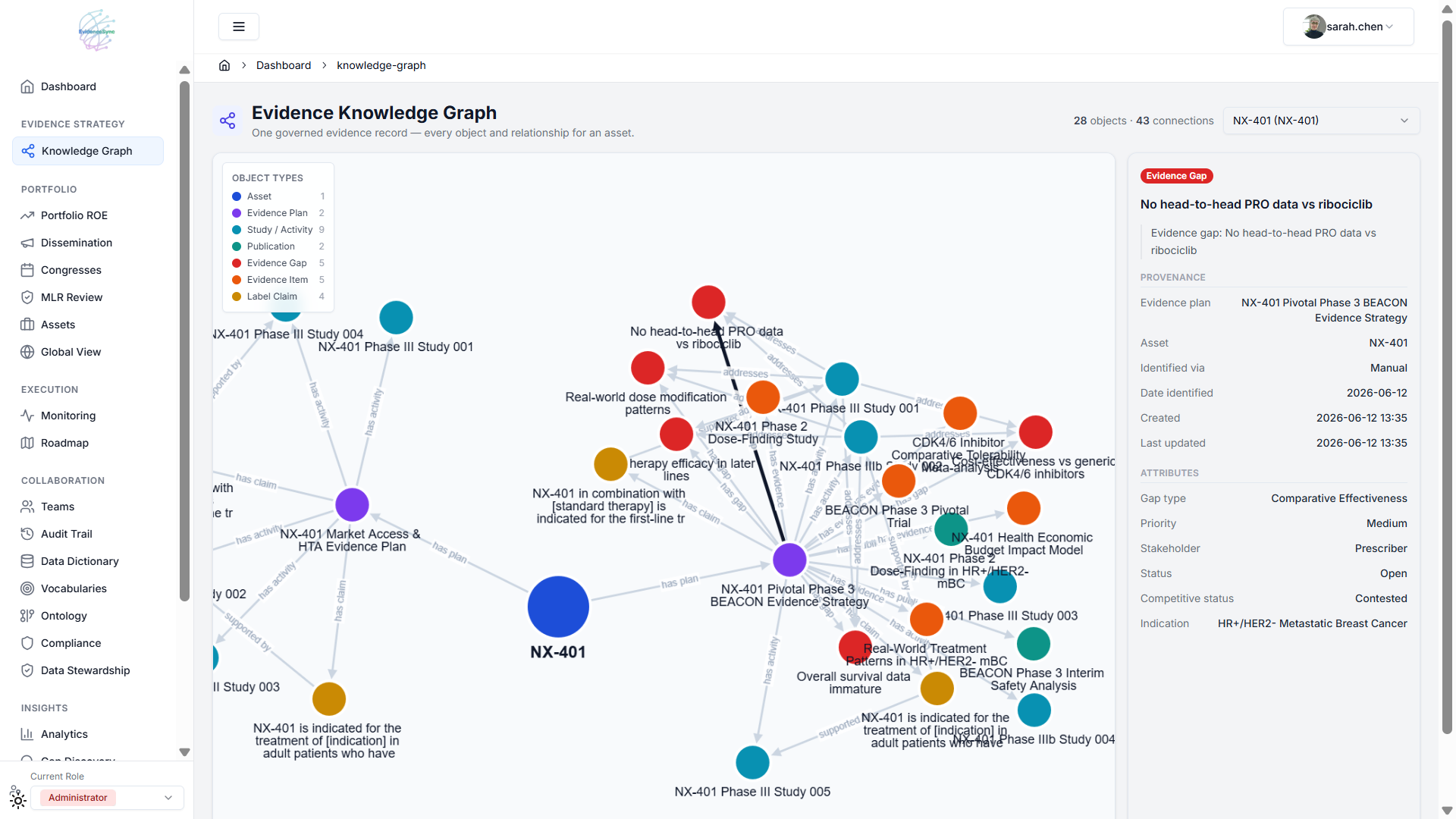
EvidenceSync agents reason over the evidence knowledge graph to detect gaps that would otherwise remain hidden across documents, systems, functions, and planning cycles. Each gap is linked to the source record, the affected objective, the stakeholder need, and the downstream decision it may impact.

Objective gapA strategic objective lacks sufficient evidence support.
Claim gapA planned claim is not backed by enough source evidence.
Stakeholder gapA payer, regulator, HCP, patient, or internal stakeholder need is not addressed.
Timing gapEvidence will not be available before the decision point.
Dissemination gapEvidence exists but has no clear publication, congress, or communication path.
Regional gapEvidence is insufficient for a specific market or geography.
Quality gapEvidence exists but may not be robust enough.
Ownership gapAn activity, gap, or decision has no accountable owner.
Duplication gapMultiple teams are funding overlapping or redundant work.
EvidenceSync Evidence Knowledge Graph for asset NX-401 showing a node-link map of studies, evidence gaps, and plans with a selected evidence gap detail panel
Evidence Graph
Stage 05 · Define Actions

Action Definition

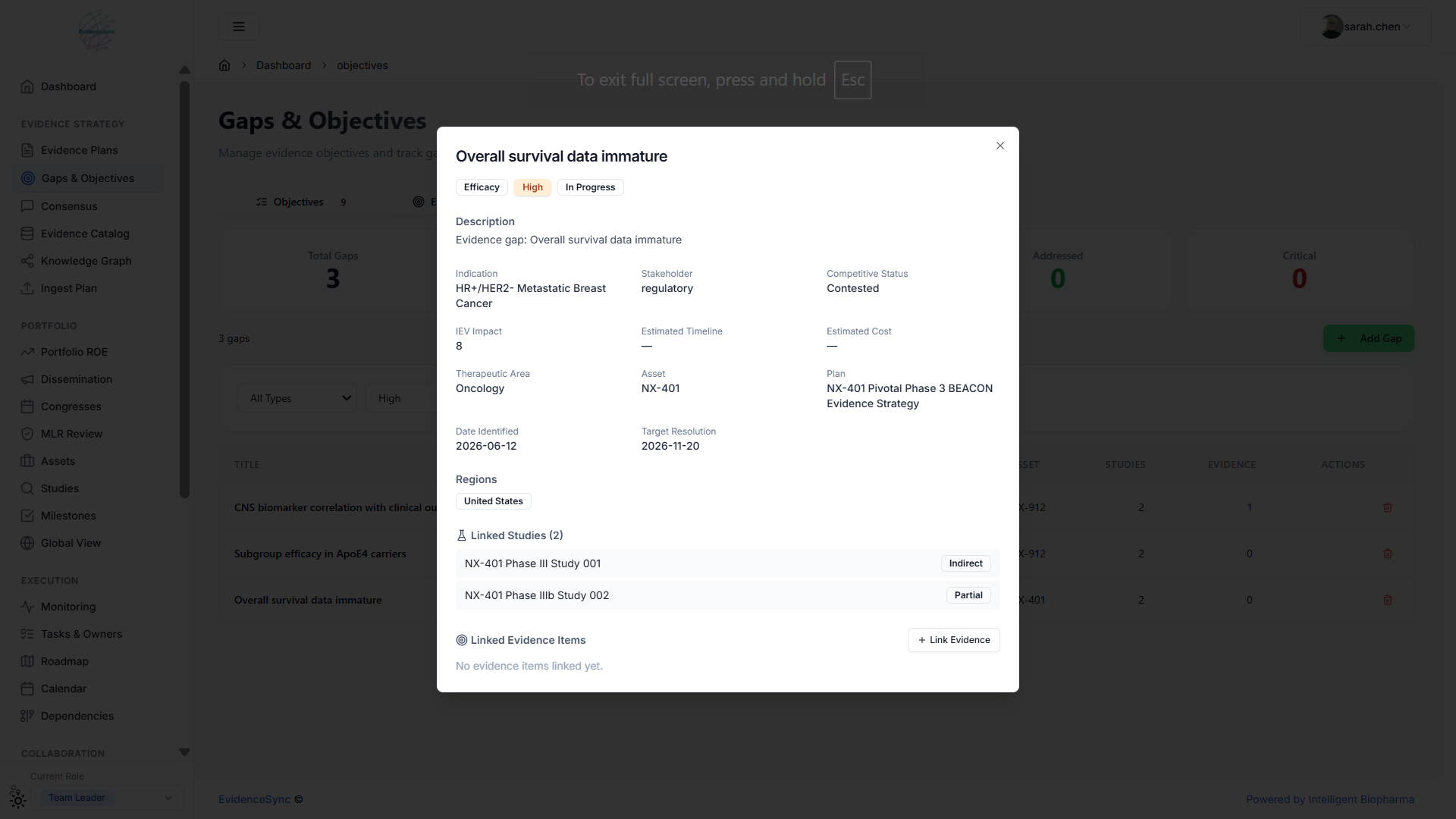
EvidenceSync does not stop at gap detection. It converts gaps into structured, reviewable action objects with rationale, ownership, timing, recommended evidence activity, affected stakeholders, dependencies, review pathway, and ROE scoring.

Gap addressedRecommended actionSource-backed rationaleEvidence objectiveAsset and indicationStakeholder impactedProposed evidence activityOwnerTimelineDependenciesRisk if unresolvedEstimated cost or effortROE scoreReview statusDecision history
EvidenceSync Gaps & Objectives view with an open evidence gap detail showing status, indication, linked studies, and structured attributes for asset NX-401
Gaps & Objectives
Stage 06 · Prioritize

Prioritize with Return on Evidence

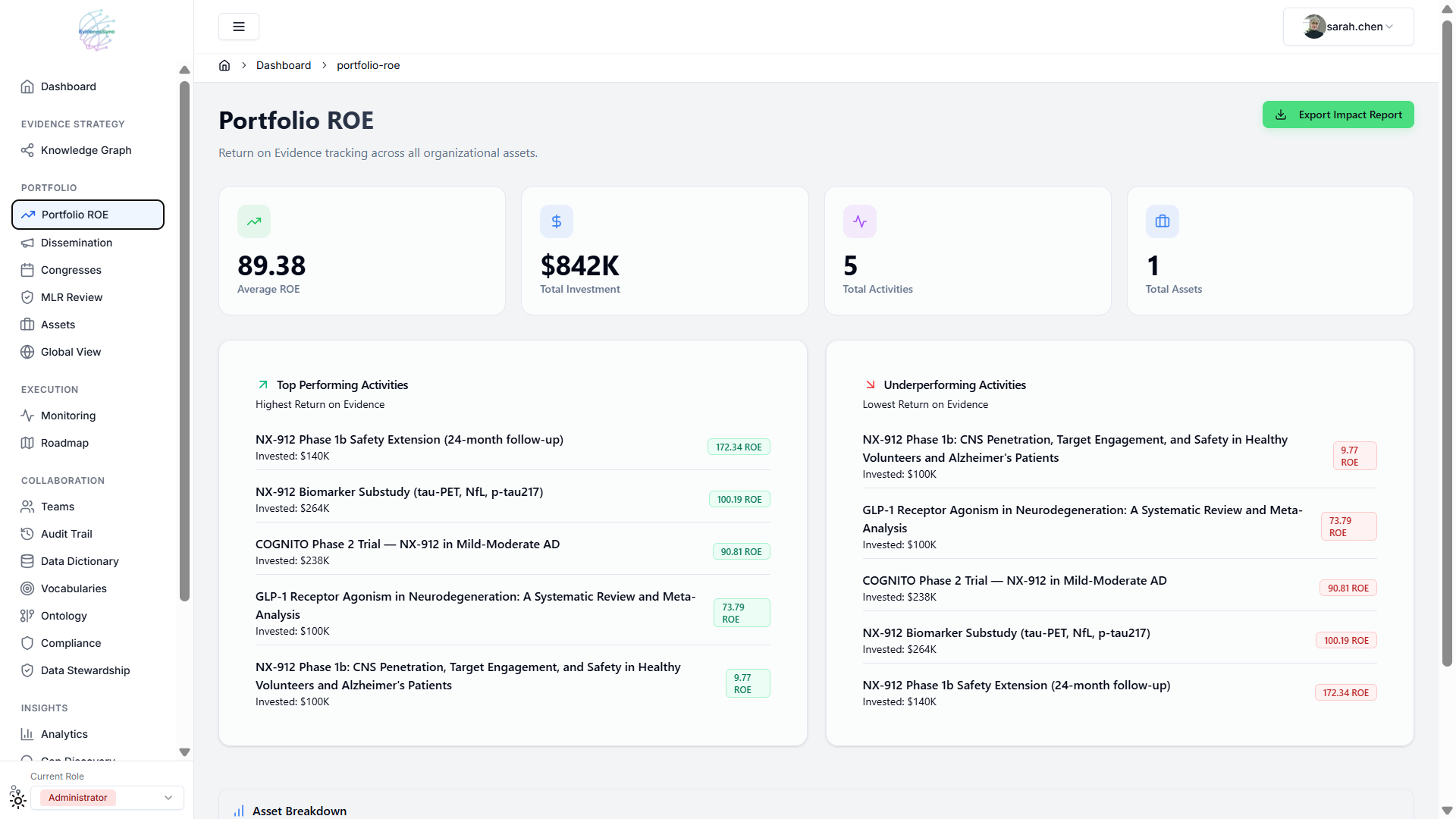
Every defined action carries an ROE score, so prioritization is explicit instead of political. Compare actions by strategic value, cost, feasibility, timing, and evidence impact, at activity, asset, and portfolio level.

The Return on Evidence framework
EvidenceSync Portfolio ROE dashboard showing average ROE, total investment, and top performing versus underperforming evidence activities
Portfolio ROE Dashboard
Stage 07 · Review

Review across functions

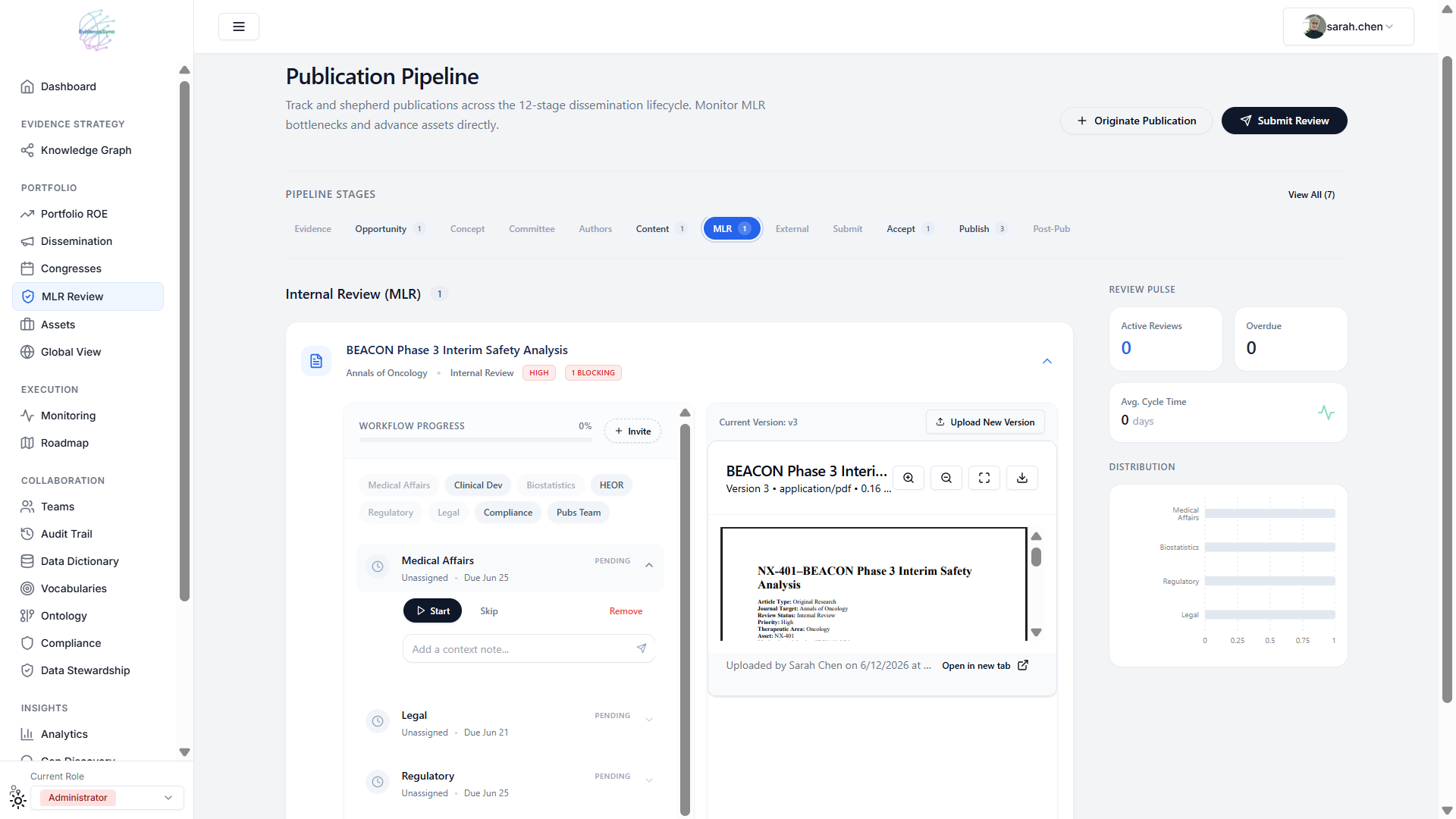
Every function sees the same evidence record through the lens of its role, responsibilities, and decision rights.

Medical Affairs LeadHEOR LeadRegulatory Intelligence ManagerPublications LeadEvidence Generation LeadMarket Access LeadReviewer or ApproverExecutive SponsorAuditor or Governance Lead
Role-based work queuesCommentsAssignmentsReview statusApprovalsVersioningAudit trailsObject ownershipCross-functional decision records
EvidenceSync Publication Pipeline showing the MLR internal review stage with department workflow steps, document preview, and review pulse metrics
Role-Based Review Queues
Stage 08 · Execute

Execute

Accepted actions become evidence activities with owners, milestones, and dependencies tracked against the plan, all on the same governed record.

Stage 09 · Disseminate

Data Dissemination Planning connected to evidence strategy

EvidenceSync connects evidence generation to Data Dissemination Planning, helping teams align publications, congress activity, stakeholder communications, internal summaries, and review-ready outputs with the underlying evidence strategy.

Data Dissemination PlansPublication plansCongress plansInternal evidence summariesLeadership reportsStakeholder communication packagesReview-ready claim packagesEvidence gap briefsPayer and regulatory evidence narrativesAdvisory board synthesis outputs
Stage 10 · Defend

Audit Trail and Compliance

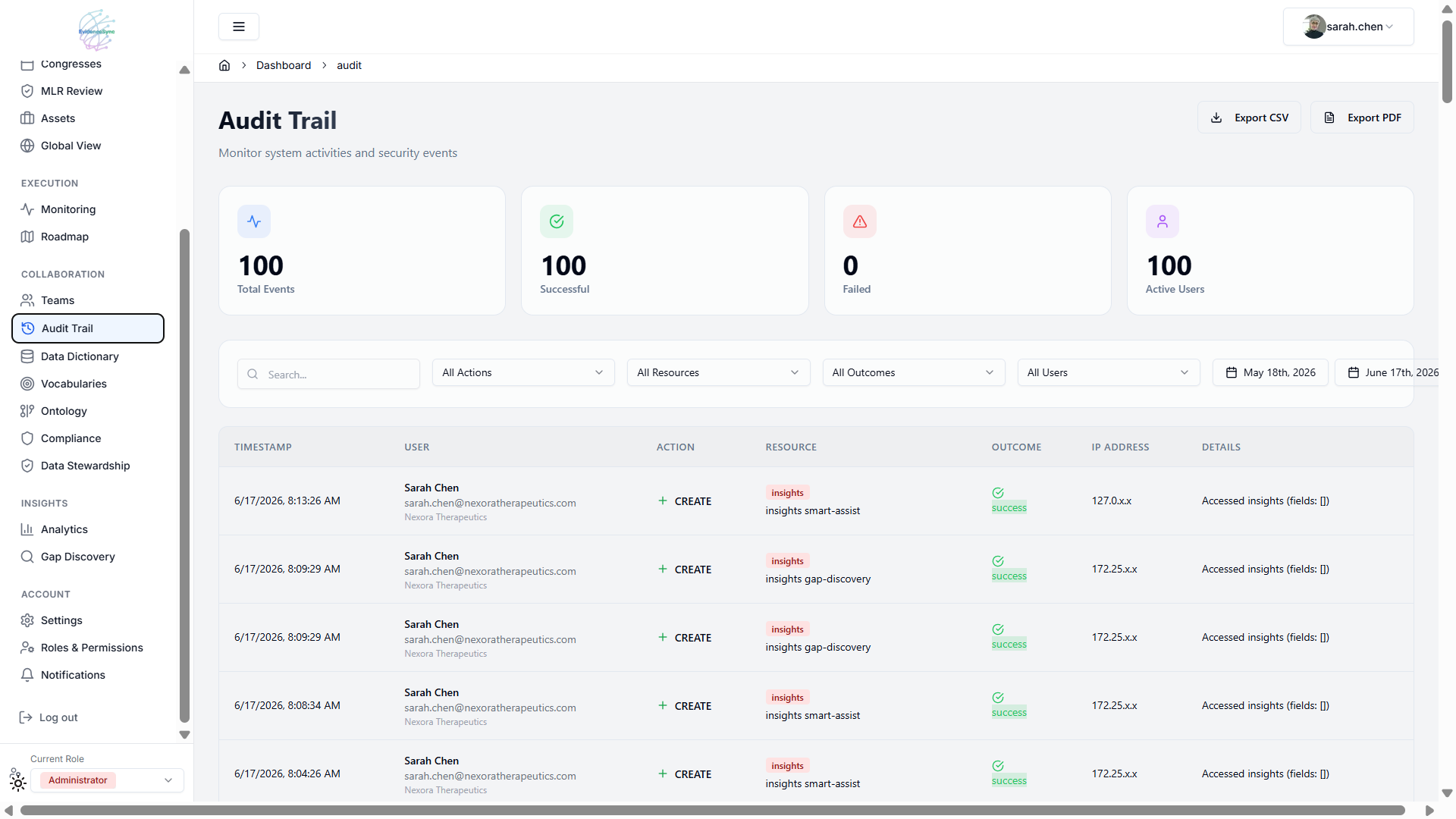
Every recommendation, score, review, and decision remains traceable to source. When the strategy is questioned, internally, by governance, or by an auditor, the rationale is already on the record.

EvidenceSync Audit Trail view showing event totals, success and failure metrics, filters, and a detailed log of user actions with outcomes and IP addresses
Audit Trail and Compliance
The governance layer wraps all ten stages
RBAC, audit trails, source traceability, and claim integrity are constant across the workflow, not a stage you reach at the end.
Security and compliance
Agentic AI, governed by evidence

Not a chatbot layer.

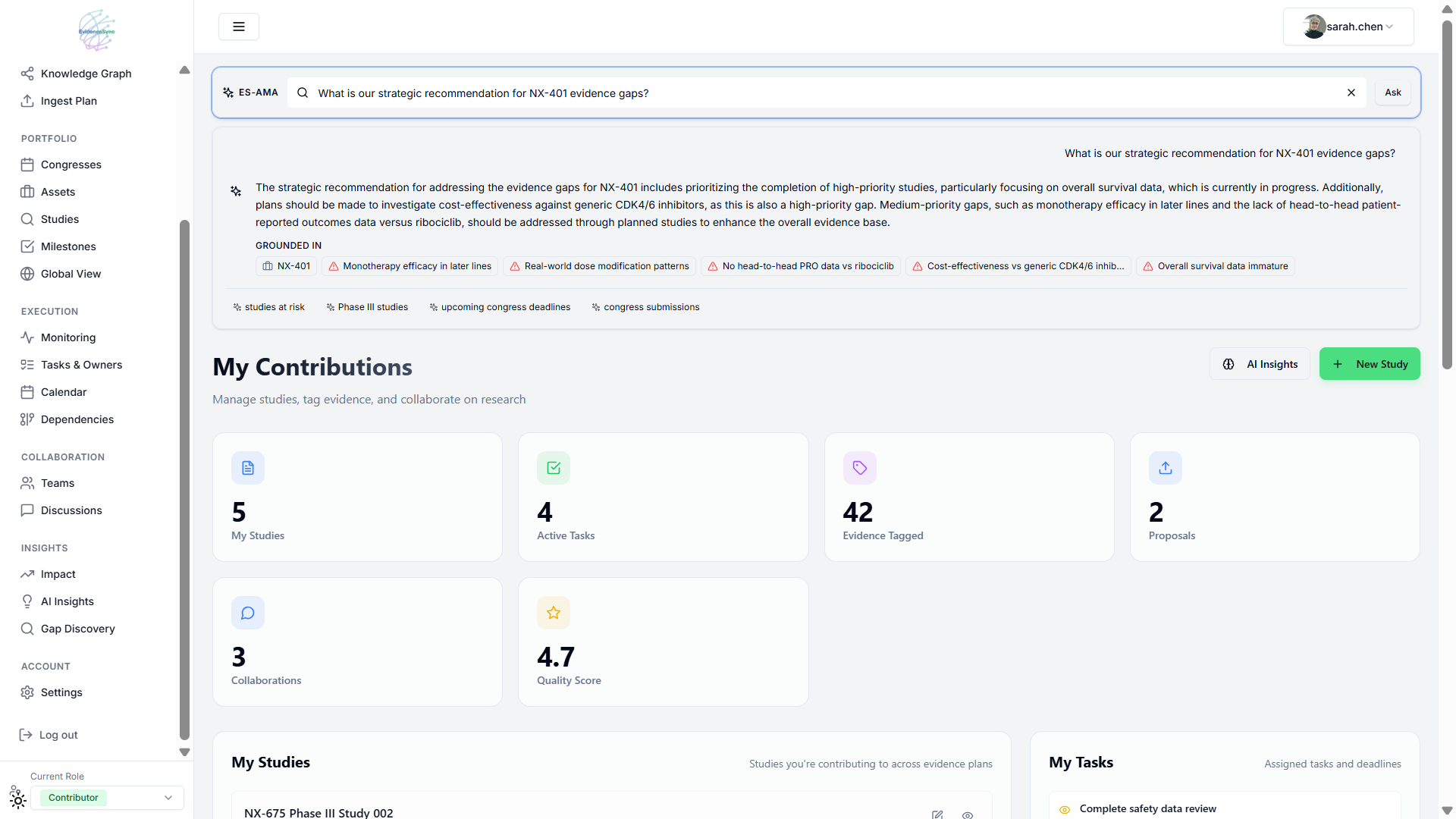
EvidenceSync does not use AI as a generic chatbot layer. Its agents operate over a governed evidence knowledge graph, where evidence objects, claims, gaps, actions, activities, stakeholders, plans, and dissemination outputs are connected and traceable.

Surface evidence gapsRecommend evidence activitiesDefine source-backed actionsCompare value using Return on EvidenceLink recommendations to source evidenceSupport IEP-to-DDP planningPreserve traceability for review and audit
EvidenceSync ES-AMA Ask Me Anything view answering a strategic recommendation question for NX-401 with grounded-in source citation chips
ES-AMA (EvidenceSync "Ask-me-Anything")
Integrations

Built to connect the evidence ecosystem

EvidenceSync is designed to integrate with the systems where evidence work already happens, including document repositories, clinical data environments, publication planning systems, medical information tools, CRM or insight platforms, and internal knowledge bases. Phase 1 supports structured ingestion and controlled document-based workflows. Enterprise integrations can be configured based on customer environment and deployment requirements.

Architecture

Traceability by design.

EvidenceSync is built on a governed evidence knowledge graph with agentic AI workflows layered on top. Agents retrieve from approved evidence sources, reason across connected evidence objects, generate source-backed recommendations, and route outputs through role-based review. The architecture is designed for traceability, governance, and regulated evidence workflows.

See the workflow
on your evidence.

A tailored walkthrough, stage by stage, on a record that looks like yours.